
Leadership & Management
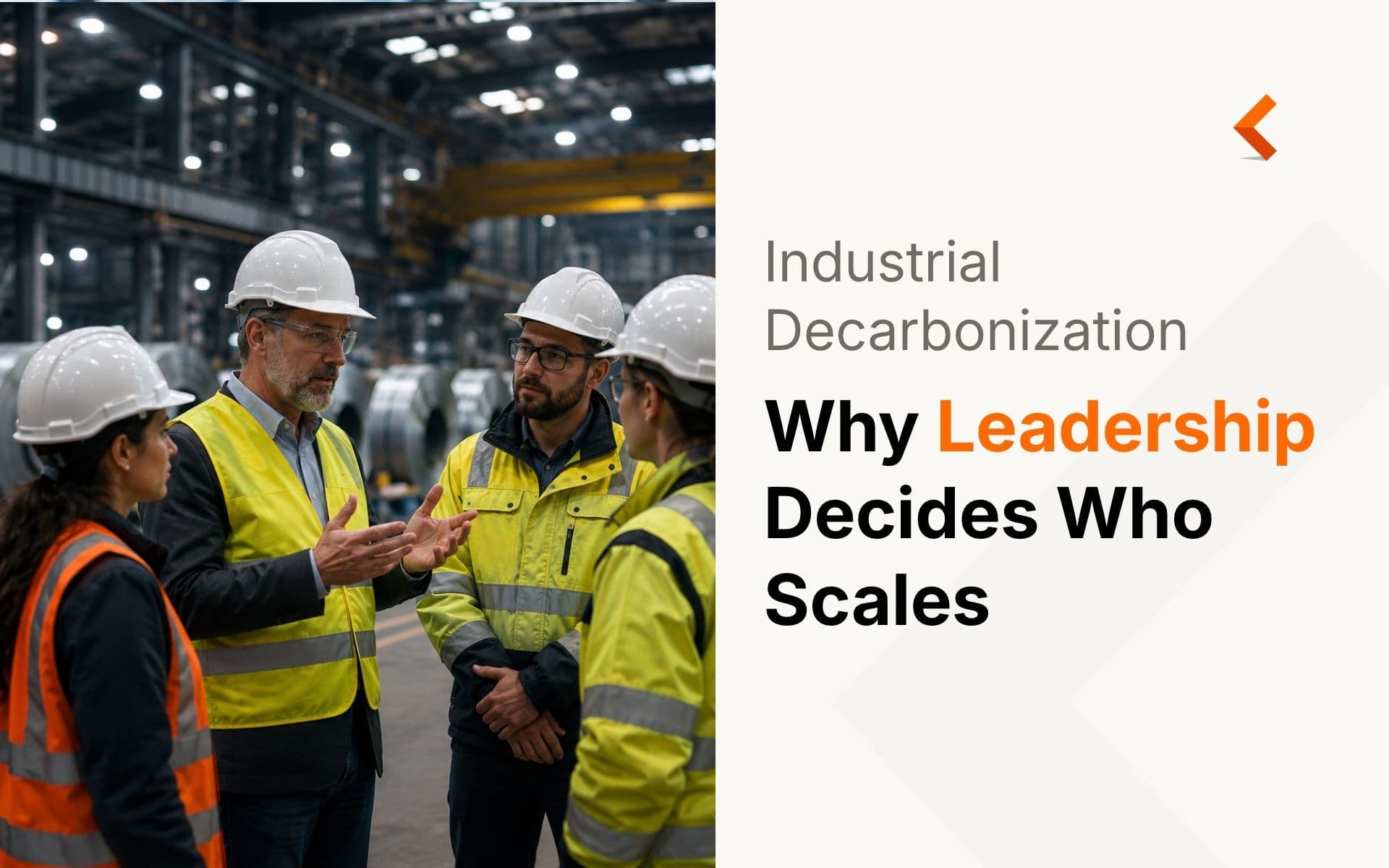
Industrial Decarbonization Beyond the Policy Cycle: Why Leadership Decides Who Scales
Every election reshapes the clean energy debate. But in industrial decarbonization, the companies that scale aren’t the ones that predict policy best. They’re the ones with leaders who can deliver.
- Published
- Read time
- 7 min read

The US midterms have, predictably, triggered another round of questions about clean energy. Will investment return? Will federal support become more predictable? Which technologies benefit from the latest shift in Washington?
All reasonable questions. But an industry requiring billions in investment and years of infrastructure development can’t reset its strategy every election night.
I spend much of my time in executive search working with companies developing technologies across carbon capture, alternative fuels, maritime decarbonization, critical metals processing and recovery, and novel industrial processes. From that perspective, the gap between political headlines and commercial reality is difficult to ignore.
There’s no shortage of impressive technology, accomplished scientists or ambitious founders. What’s harder is turning something that works in a controlled environment into a commercially viable product that industrial customers will adopt.
And a more favorable political environment doesn’t make that any easier.
Policy Is a Tailwind, Not a Business Model
The Inflation Reduction Act created significant momentum for clean technology investment. The subsequent change in administration showed how quickly that environment can shift.
In October 2025, the US Department of Energy announced the cancellation of more than $7.5 billion in awards. The decision showed how exposed emerging technologies that depend on government support can be.
Rhodium Group’s Clean Investment Monitor reported that US clean energy and transportation investment fell 9% year over year in the first quarter of 2026, while clean technology manufacturing investment declined 34%.
Interestingly, carbon management investment increased 63% over the same period, while investment in critical minerals projects, part of the manufacturing category, rose 22%.
That divergence matters: the picture is more complicated than a straightforward retreat from decarbonization.
According to NPR’s analysis of race calls, Democrats have won control of both chambers of Congress, which introduces greater scope for scrutiny of federal energy policy and funding decisions.
But a change in congressional control isn’t a change in administration. President Trump retains executive authority and veto power, so substantial policy reversals would require political cooperation that may prove difficult.
Government incentives can help emerging technologies compete with established industrial solutions. But there’s a difference between using public support to accelerate commercialization and relying on it indefinitely to make the economics work.
Decarbonization Isn’t One Market
One frustration I have with the broader decarbonization discussion is the tendency to treat fundamentally different technologies as though they face the same commercial challenges.
Apparently, if two businesses are reducing emissions, their markets must be broadly comparable.
They aren’t.
Maritime decarbonization is a good example.
Developing an alternative fuel system, onboard emissions technology or novel propulsion solution is one challenge. Convincing a shipowner to install it, accept the operational implications and commit capital to an evolving technology is another entirely.
Shipowners prioritize reliability, safety, fuel availability, maintenance and vessel downtime. An impressive emissions reduction figure means little if the technology introduces unacceptable operational risk.
Developers must also navigate international regulations, classification societies and vessels operating across multiple jurisdictions.
The global shipping industry, somewhat inconveniently, operates globally.
Carbon capture presents different challenges. A technology may demonstrate excellent capture performance while the broader project remains constrained by energy consumption, transportation infrastructure, storage availability or financing.
In both markets, technical feasibility is only one part of commercial success.
AI Is Changing the Energy Equation
The rapid expansion of artificial intelligence is adding another dimension to US energy policy. E&E News reports that a new Lawrence Berkeley National Laboratory analysis puts data centers at roughly 10% to 15% of US electricity use by the end of the decade, up from roughly 4.5% today.
There’s a certain irony in spending years discussing how to reduce energy consumption, only to develop a technology requiring enormous amounts of additional electricity.
For decarbonization businesses, that can create commercial opportunities. Technologies that improve efficiency, thermal management, power generation or emissions performance may attract customers motivated by infrastructure constraints and operating economics rather than environmental commitments alone. And unlike political commitments, demand for reliable electricity is unlikely to disappear after the next election.
Good Technology Doesn’t Automatically Build a Good Business
This is where my experience in executive search has shaped how I view the sector.
I’ve worked with businesses built around innovative technologies and technically accomplished founders. The challenge is rarely technical ambition. It’s the transition from proving a technology works to delivering it commercially.
An early-stage company developing a novel industrial process might initially need exceptional research leadership. As it approaches deployment, the priorities shift toward engineering scale-up, project delivery, manufacturing, customer qualification and commercial contracts.
The business still needs brilliant scientists. It now also needs people who understand how industrial projects get delivered.
Inventing something and building a profitable business around it turn out to be separate disciplines.
One executive search illustrates the challenge.
A metals recovery technology business had successfully raised investment and was progressing toward broader commercial deployment.
The question was no longer simply whether the process worked. It was whether the company had the leadership capability to deploy it at scale.
The CTO brief required someone who had commercialized emerging technologies, led technical teams and delivered large-scale industrial projects.
That’s a different profile from someone whose experience is primarily research-led.
Getting that appointment wrong carries consequences beyond recruitment costs: project execution, capital efficiency and the next funding round.
Investors can fund the technology. They can’t simply fund their way out of poor execution once the capital has been spent.
The Leadership Problem Investors Can’t Ignore
For investors and boards, the questions are straightforward.
Has this team delivered anything comparable at the scale we’re attempting? Who has managed a major industrial project when costs start moving in the wrong direction? Who understands commercial contracting and the operational realities of scaling?
A technically brilliant leadership team is reassuring until someone asks who has actually built a commercial facility or negotiated a major customer agreement.
Equally, recruiting from a major industrial corporation isn’t automatically the answer. An executive used to substantial resources and established processes may struggle in a venture-backed business where priorities shift quickly and infrastructure must be built alongside the company.
Finding people who combine relevant industrial experience with that adaptability is considerably harder than an impressive resume might suggest.
Finding Leadership Beyond the Obvious Markets
One of the most interesting aspects of recruiting within emerging decarbonization technologies is that the strongest candidates often come from unexpected industries.
There simply aren’t enough executives who have already scaled businesses in some of these specialized markets.
For maritime technology, relevant experience might sit in industrial gases, conventional marine engineering, power conversion or complex equipment manufacturing.
For carbon capture, it might come from chemicals, process engineering or traditional energy infrastructure.
This is where AI becomes genuinely useful in executive search.
At CGP Group, we use Keystone AI to broaden our research beyond traditional industry boundaries, identifying executives with relevant technical, operational and commercial experience who might otherwise be overlooked.
But a strong resume is only the beginning. Understanding whether someone has delivered comparable projects, operated at the right scale and can succeed in a developing business still requires detailed assessment.
Despite enthusiastic predictions about AI replacing entire professions, knowing which questions to ask and understanding the answers remains rather useful.
Technology helps identify possibilities. It doesn’t replace industry knowledge or human judgment.
Find Leaders Beyond the Obvious Markets
See how Keystone AI helps our consultants search across adjacent industries, so strong candidates don’t get overlooked.
Request DemoWhat Happens Next?
I don’t think the midterms fundamentally change US industrial decarbonization overnight.
They may influence investment sentiment, federal policy and support for individual technologies. But the bigger shift is already happening.
Investors are becoming more demanding about commercial timelines, capital requirements and credible routes to revenue.
Industrial customers want technologies that work reliably, integrate into existing operations and justify their cost.
And emerging businesses need leadership teams capable of delivering against those expectations.
An innovative technology, an ambitious emissions target and a polished investor presentation are no longer enough.
Eventually, someone asks how much it costs, who’s buying it and when it starts making money.
I see that as a healthy development. Greater commercial scrutiny should distinguish technologies with long-term potential from those unlikely to progress beyond demonstration.
There will be winners and losers, and policy will continue to influence the pace of development.
But the next phase of industrial decarbonization will depend less on who makes the boldest promises and more on who can actually deliver.
Thankfully, commercial reality has a habit of remaining relevant regardless of who’s occupying the White House.
Hiring Leaders for an Emerging Technology?
Our executive search team finds leaders who can take new technologies from pilot to commercial scale, often from industries you wouldn’t think to look.
Talk to Our TeamFrequently Asked Questions
When should a founder-led decarbonization company hire commercial or operational leadership?
Before the transition from technology validation to commercial deployment becomes a bottleneck. Demonstration projects, customer qualification and manufacturing scale-up often require experience beyond the founding team.
Should emerging technology businesses recruit executives from outside their immediate industry?
Often, yes. Experience in adjacent industrial sectors can be highly transferable, particularly where candidates have delivered complex projects, scaled operations or commercialized new technologies.
When is retained executive search worth it for a decarbonization business?
When the role is critical to the business, the talent pool is small and many of the best candidates aren’t actively looking. A retained search provides dedicated research across adjacent markets and a consistent assessment of each candidate against what the business needs over the next two to three years.
Can AI improve executive recruitment in specialized technology markets?
Yes, mainly by making research faster and broader. At CGP Group, Keystone AI helps identify relevant experience across a wider range of industries, freeing our consultants to spend more time with candidates and clients. But efficiency isn’t judgment: assessing technical credibility and commercial leadership still takes specialist knowledge and human assessment.




Your Global Workforce. Simplified.
Start a conversation to explore how Keystone AI's RaaS ecosystem fits your hiring needs. Whether you're scaling a startup or optimizing enterprise talent operations.