Case Study
What a Year of Real Nearshore Staffing Looks Like
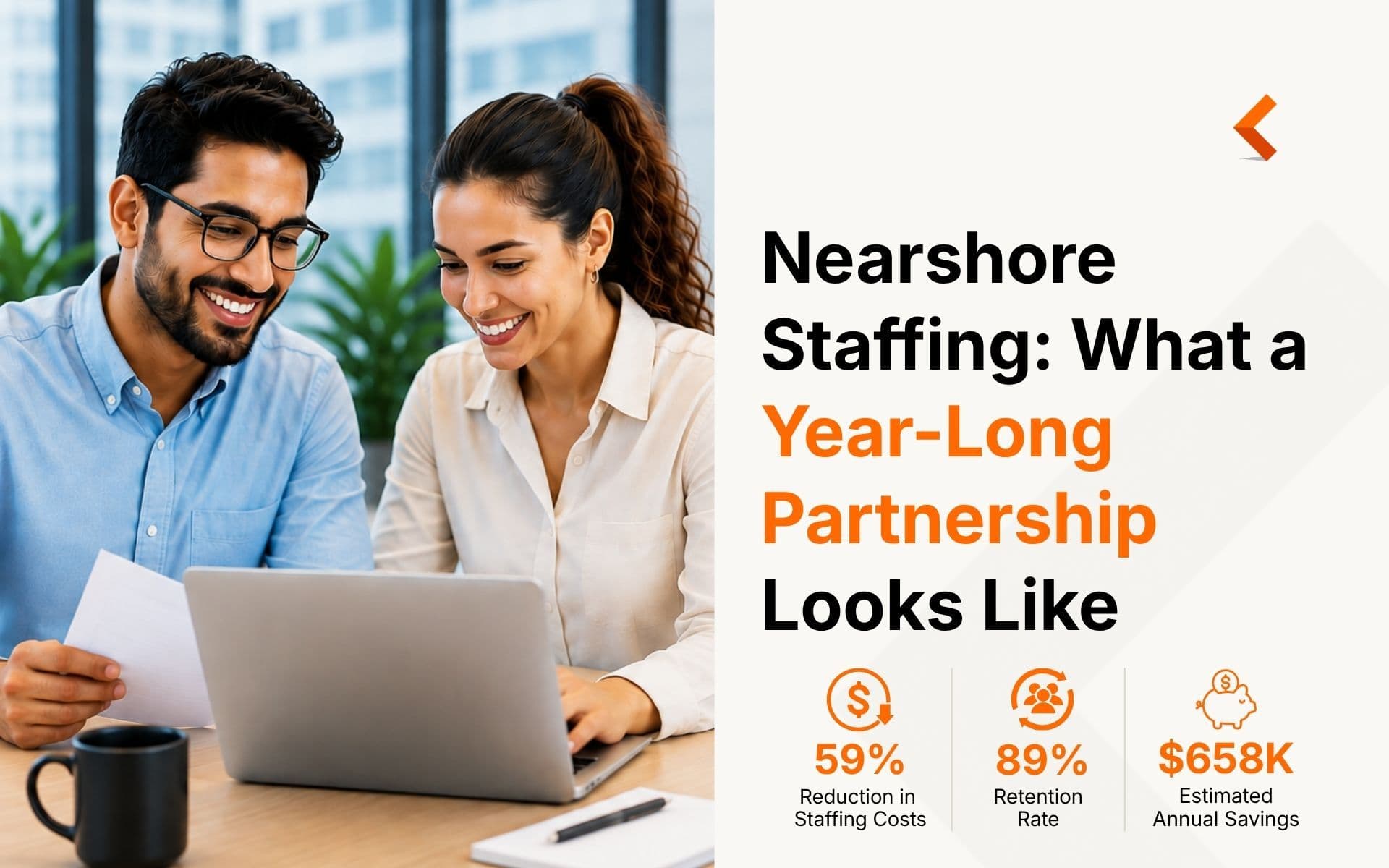
What does a successful nearshore staffing partnership actually look like after a full year? This case study explores how a US-based HR and benefits company built a 13-person nearshore team across four functions, achieving 89% retention while reducing staffing costs by 59%.

A year ago, a US-based HR and benefits outsourcing company came to us with a familiar challenge: they needed more people to support a growing workload, but they also needed those people to fit the way their business actually worked.
They weren't simply looking for a staffing vendor. They were looking for a nearshore staffing partner that could help them access qualified talent, build specialized teams, and scale their workforce as their needs changed.
What started with one benefits specialist in August 2025 eventually grew into 13 active consultants across four functions, supporting the client's PEO and HR operations.
This is what a nearshore staffing model can look like when it becomes a long-term workforce solution rather than a one-off recruitment exercise.
What Is Nearshore Staffing?
Nearshore staffing is a workforce model that allows companies to build teams in nearby countries or regions while maintaining close collaboration with their local operations.
For U.S.-based companies, nearshore staffing can provide access to qualified international talent while helping organizations manage operating costs, expand capacity, and build dedicated teams across functions such as HR, payroll, finance, customer support, IT, and administration.
The model can take different forms. Some companies use nearshore staffing for individual specialist roles. Others build entire functional teams that operate as an extension of their existing workforce.
This partnership started somewhere in between and grew from there.
From One Placement to a Nearshore Team
The first placement was made in August 2025: one benefits specialist brought in to help absorb a growing workload.
A month later, the client came back with another request. This time, they needed three payroll specialists as they took on a new function.
By November, the relationship had expanded again, with HR and contact center roles joining the mix.
By the following summer, the partnership had grown to 13 active consultants across four functions.
There was no single moment when the team suddenly scaled.
It happened one successful placement at a time.
That progression is one of the things we value most about a long-term staffing partnership. When a client comes back after the first placement and asks for another person, then another team, then another function, it usually means the relationship has moved beyond simply filling vacancies.
There is trust in the process.
How the Nearshore Staffing Model Was Structured
As the team grew, the way it was managed had to grow with it.
Instead of placing all 13 consultants under one generalist manager, the teams were structured around their functions.
Benefits Operations had its own manager. Payroll had another. HR had another.
That gave each group a more focused point of contact — someone who understood the work, the priorities, and the challenges that came with each function.
For Benefits Operations, that could mean understanding open enrollment cycles. For Payroll, it meant working around strict payroll deadlines. For HR, it meant having someone familiar with the day-to-day nature of employee relations and HR case work.
This is an important part of building a successful nearshore team.
Nearshore Staffing Results at a Glance
Over the course of the partnership:
- 13 active consultants
- 4 business functions supported
- 19 total placements
- 89% retention rate
- 59% reduction in fully loaded staffing costs
- $658,000 estimated annual savings
The numbers tell an important part of the story.
But they're not the whole story.
The Cost Savings of Nearshore Staffing
One number quickly caught the attention of the client's leadership team:
$658,000 in estimated annual savings.
The comparison looked at the fully loaded cost of the same 13 roles hired locally in the US versus the nearshore staffing model.
The calculation included salary, payroll burden, desk space, IT, and other associated costs on both sides.
The result was a 59% reduction in fully loaded staffing costs.
For organizations evaluating nearshore staffing services, cost is naturally an important part of the conversation.
But cost alone doesn't make a workforce solution successful.
The more important question is what happens after the people join.
Talent Retention: What Happened After the Placements?
Across the year, there were 19 total placements.
Six people departed during that period. Only two of those departures were related to people leaving for a better offer elsewhere. The remaining departures were connected to client-driven changes or personal circumstances.
That resulted in an 89% retention rate. Retention here counts only departures for a better offer elsewhere (two of the 19 placements). Client-driven changes and personal circumstances are not counted.
More importantly, the six earliest hires are still with the client more than a year later.
For a staffing partnership, that's significant.
Retention gives us another way to look at whether the original match was right. A successful placement isn't simply someone who starts on Monday. It's someone whose experience, skills, expectations, and working environment align well enough for the relationship to continue.
That's where talent matching and retention become just as important as recruitment itself.
The People Behind the Numbers
It's easy to look at a nearshore staffing case study through the lens of cost savings and headcount.
But there are 13 people behind that number.
Each person was connected with a role that matched their experience and capabilities. Each joined a team with a specific function, a manager, and an opportunity to contribute and develop.
Six of the earliest hires are still there today.
That's important because the value of workforce solutions isn't only measured by how many positions are filled or how much an organization saves.
It's also measured by whether people find opportunities where they can do good work and continue to grow.
The client's HR leadership described the process as seamless from the beginning, highlighting the quality of the candidates, the transparency of the process, and our understanding of what they needed.
That feedback reflects both sides of the partnership: the client receiving the support it needed and the people we connected with those opportunities finding a place where they could contribute.
What Roles Can Nearshore Staffing Support?
One of the advantages of a flexible nearshore staffing model is that it doesn't have to be limited to one type of role or department.
In this partnership, the teams expanded across:
- Benefits operations
- Payroll
- HR
- Contact center support
As organizations grow, nearshore teams can also support functions such as:
- HR operations
- Finance and accounting
- Recruiting coordination
- Customer support
- IT and technical support
- Administrative operations
- Data and analytics
- Marketing and Social Media
The right model depends on the organization's workforce needs, the functions being supported, and the type of talent required.
Nearshore Staffing Is More Than Outsourcing Headcount
The term outsourcing can sometimes make the relationship sound simpler than it really is.
In this case, the goal wasn't simply to move work somewhere else.
It was to build a team that could become an extension of the client's existing operations.
That meant understanding the roles before recruiting, connecting the client with people whose experience matched the work, supporting the onboarding process, and staying involved as the team developed.
That distinction matters.
A strong nearshore staffing partner should understand both sides of the equation: what the organization needs and what the opportunity means for the person taking the role.
What Comes Next?
The partnership is still growing. As the nearshore staffing model continues to evolve, technology is also changing how talent is identified and connected to opportunities.
Keystone AI, CGP Group’s AI-powered talent platform, combines AI-driven talent matching with human expertise to help organizations connect with qualified talent across global markets.
As the client adds new functions and specialist roles, there are opportunities to expand the nearshore workforce model into areas such as HR operations, analytics, and recruiting coordination.
Based on the current model, each additional specialist role represents an average saving of around $50,000 per year compared with the equivalent local cost.
But the opportunity isn't simply about reducing the cost of each additional hire.
It's about building a workforce that works.
That means understanding the client's business, identifying the skills each role requires, connecting the right people with the right opportunities, and continuing to support the relationship after the placement.
What Makes a Nearshore Staffing Partnership Successful?
There isn't one formula that works for every organization.
But this partnership has shown us a few things that matter:
1. Start with the work, not just the job description. Understanding how a function operates helps identify the experience and capabilities the person actually needs.
2. Build around the function. Specialized teams benefit from managers and support structures that understand their specific work.
3. Look beyond the initial placement. A successful staffing relationship develops after someone joins, not just when an offer is accepted.
4. Measure retention as well as cost. Savings matter, but so does whether people stay and succeed in the roles they take.
5. Treat the relationship as a partnership. The strongest workforce solutions evolve as the client's needs evolve.
The Bigger Opportunity
The financial case for nearshore staffing is clear in this partnership: $658,000 in estimated annual savings and a 59% reduction in fully loaded staffing costs.
But those figures don't tell the entire story.
There are also 19 people who were connected with opportunities over the course of the year. There are 13 consultants currently supporting the client's operations. And there are six of the earliest hires who have now been with the team for more than a year.
That's what makes this partnership meaningful to us.
The goal of nearshore staffing isn't simply to reduce costs or add headcount. Done well, it gives organizations access to qualified talent while giving people opportunities where their skills can create real value.
That's the kind of workforce solution we're interested in building.
And ultimately, that's what talent delivery should be about: connecting the world's talent to opportunity and creating partnerships that work for both sides.
Looking for your next opportunity?
Our work is ultimately about people — helping organizations build strong teams while connecting talented professionals with opportunities where they can grow and make an impact.
Explore open opportunities on Keystone AIInterested in building a nearshore team?
If your organization is exploring nearshore staffing, workforce solutions, HR outsourcing, or building a dedicated international team, CGP Group can help you evaluate the right model for your business.
Contact CGP Group