Talent Insights
5 Hiring Mistakes That Cost Companies the Most in 2026
The most expensive hiring mistakes in 2026 aren't the ones you notice. They're the ones quietly built into the playbook. Here are five and what the best hiring teams are doing instead.

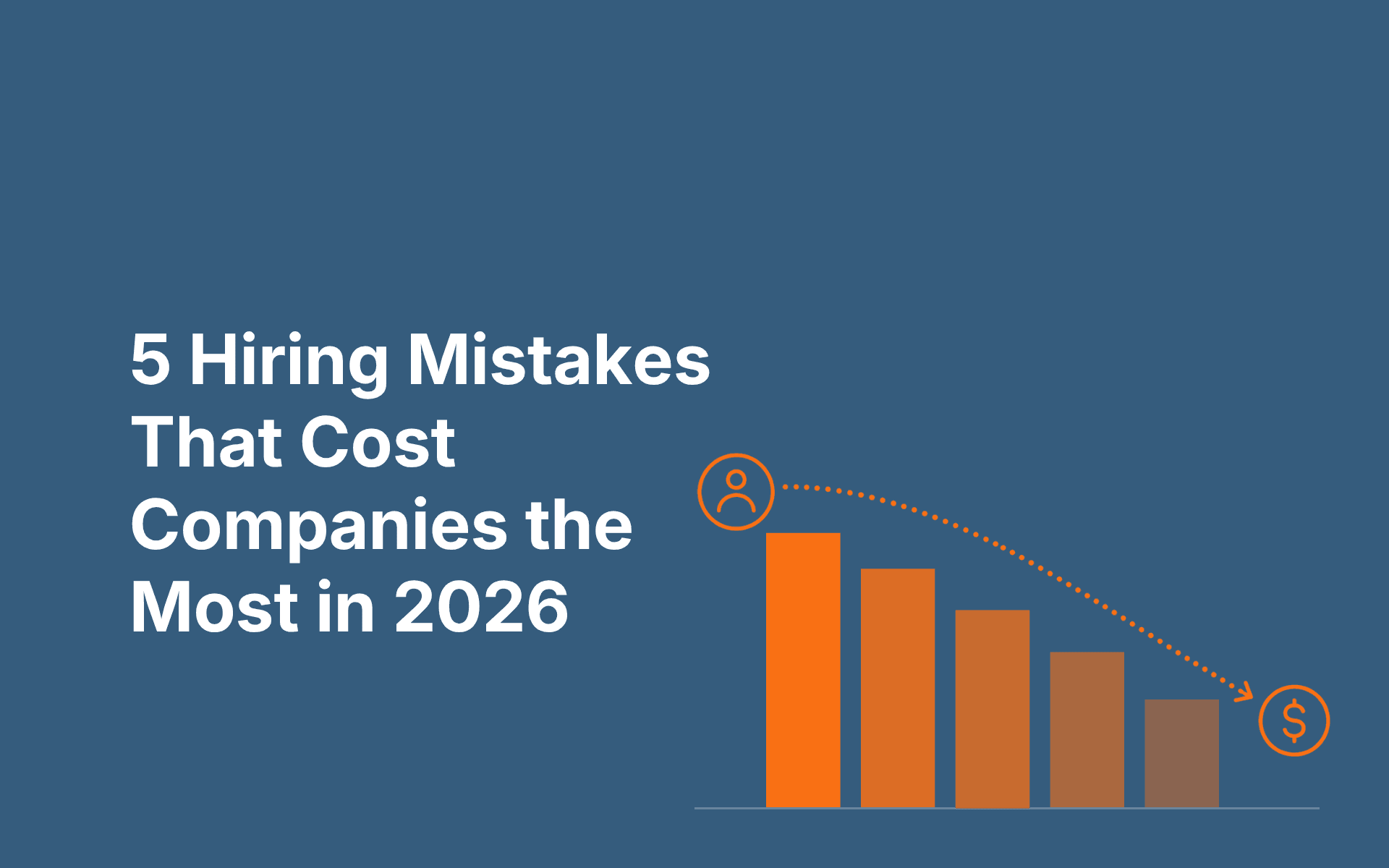
The most expensive hiring mistakes in 2026 aren't the ones companies notice. They're the ones built into the playbook.
Hiring is more expensive than ever.
Salaries are up. Recruiter fees are up. Time-to-hire is up. The cost of a bad hire or the wrong person in the wrong seat has tripled since 2020 in most mid-market companies.
But most of that cost is invisible. Hiring managers see the agency invoice and the salary line. They don't see thesix months of stalled outputfrom a misfit hire, theteam morale taxof a bad cultural match, or theopportunity costof running a search the wrong way for ninety days.
In 2026, the most expensive hiring mistakes aren't the ones you notice. They're the ones quietly baked into how your team runs every search.
Here are the five we see again and again and what the best hiring teams are doing instead.
1. Hiring against a job description instead of an outcome
Most hiring still starts the same way: copy last year's job description, change the salary band, post it.
The problem is that job descriptions describeactivities, notoutcomes. "Manage the marketing calendar" is an activity. "Take demo bookings from 80/month to 250/month in 12 months" is an outcome. Activities can be filled by anyone with the right resume. Outcomes require a specific kind of person.
When you hire against a JD (Job Description), you get candidates who match the description. When you hire against an outcome, you get candidates who can actually do the job.
What the best teams do instead: Before writing the JD, the hiring manager defines the three most important outcomes the new hire must deliver in their first 12 months. The shortlist gets scored against those outcomes not against years of experience or keyword matches.
2. Treating skills assessment as optional
The 2026 résumé is not the same artifact it was in 2020.
AI can write a stronger résumé than most candidates ever could. Job titles can be optimized. Past responsibilities can be reframed. The gap betweenwhat a résumé claimsandwhat a candidate can actually dohas never been wider.
And yet most companies still rely primarily on résumés for first-round filtering, followed by behavioral interviews to "get a feel."
That's how you end up four weeks into the process realizing the candidate can't do the work.
What the best teams do instead: Skills are assessedbeforethe first interview. A short, role-specific task (45 minutes, paid). A structured case study. A live problem-solving conversation. Anything that surfaceswhat the candidate can actually donot just what they say they can do.
The best part: this also filters out 70% of low-fit candidates before any human time gets spent on them.
3. Optimizing time-to-hire over quality-of-shortlist
For two decades, time-to-hire has been the headline number every talent team optimized for.
Wrong metric.
Time-to-hire optimizes forclosing fast. It doesn't optimize forclosing well. A 21-day hire who quits in six months is dramatically more expensive than a 35-day hire who stays four years but on a time-to-hire dashboard, the first one looks like a win.
The metric that actually matters is time-to-vetted-shortlist how quickly you get a list of candidates who genuinely meet your bar. Once that list is in your inbox, the rest is downstream. Until then, every day is wasted motion.
What the best teams do instead: Track shortlist quality first (acceptance rate, retention at 12 months, performance ratings) and shortlistspeedsecond. Reward recruiters for hires that stay, not for hires that close fast.
4. Treating AI fluency as a "nice-to-have"
In 2026, AI fluency is what computer literacy was in 2010.
The candidate who can leverage AI tools to do their job 2-3x faster is not a curiosity. They are the new baseline. Hiring someone today whodoesn'tknow how to integrate AI into their workflow is hiring future obsolescence at full salary.
And yet most job descriptions still treat "familiarity with AI tools" as an optional bonus, listed alongside "knows Excel."
What the best teams do instead: Vet for AI fluency explicitly. Not by asking "do you use ChatGPT" (everyone says yes). Ask candidates to walk through a real task they've completed using AI the specifics reveal depth. Look for prompt iteration, sanity-checking of AI output, ability to spot when AI is wrong.Thoseare the markers of an AI-fluent worker.
If the candidate is going to be doing knowledge work, AI fluency is no longer optional. It's the role.
5. Trying to do all of this alone
This is the meta-mistake. The one underneath the other four.
Every hiring team in 2026 is being asked to do more with less: source from a global talent pool, vet for skills and AI fluency, run faster shortlists, hit retention targets, manage compliance across borders, and somehow keep up with a candidate market that shifts every quarter.
The math doesn't work. Not for an in-house team. Not for a traditional recruiting agency that hasn't updated its playbook since 2015. The complexity has compounded faster than the team has scaled.
The companies winning at hiring in 2026 are the ones that stopped trying to do it all internally and started working with partners who've built modern delivery models around exactly this complexity. Smarter sourcing. Structured vetting. Cross-border compliance. AI-powered intelligence layered onto expert human judgment.
It's not about outsourcing the hiring function. It's aboutamplifyingit so the work that actually requires human judgment gets the time and focus it deserves, and everything else runs as a system.
At CGP Group, we've spent the last 14 years building one of the most curated hiring intelligence systems in the industry across the Americas, Asia Pacific, and the Middle East. And the last two years have changed how that system works.
We've been quietly building something specifically designed to close the gaps above combining the speed and pattern recognition of AI with the judgment of expert recruiters who actually know your business. Faster shortlists. Smarter vetting. Fewer mis-hires.
More on this very soon.
If you want a preview before launch, follow us on LinkedIn CGP Nearshore. We'll keep you in the loop.