
Technology & AI
From AI Pilots to AI Profit: Closing the Implementation Gap in 2026
Most companies are using AI somewhere. Very few are getting paid for it. Here's where the return actually shows up, and what it takes to get there.
- Last updated
- Read time
- 5 min read

AI implementation is becoming an operating advantage
A couple of years ago, most of the conversations I had about AI started with curiosity. Leadership teams wanted to know what it could do. That phase is over. Today the question I hear is sharper, and more commercial: how quickly can we turn AI into something that shows up in the numbers?
The case for AI is getting harder to ignore. Goldman Sachs has noted that employees using enterprise AI tools save 40 to 60 minutes a day on average. On a 100-person team, that adds up to somewhere between 17,000 and 25,000 hours of capacity every year. That's the equivalent of adding several full-time people without adding a single salary.
And yet.
What the AI implementation gap looks like
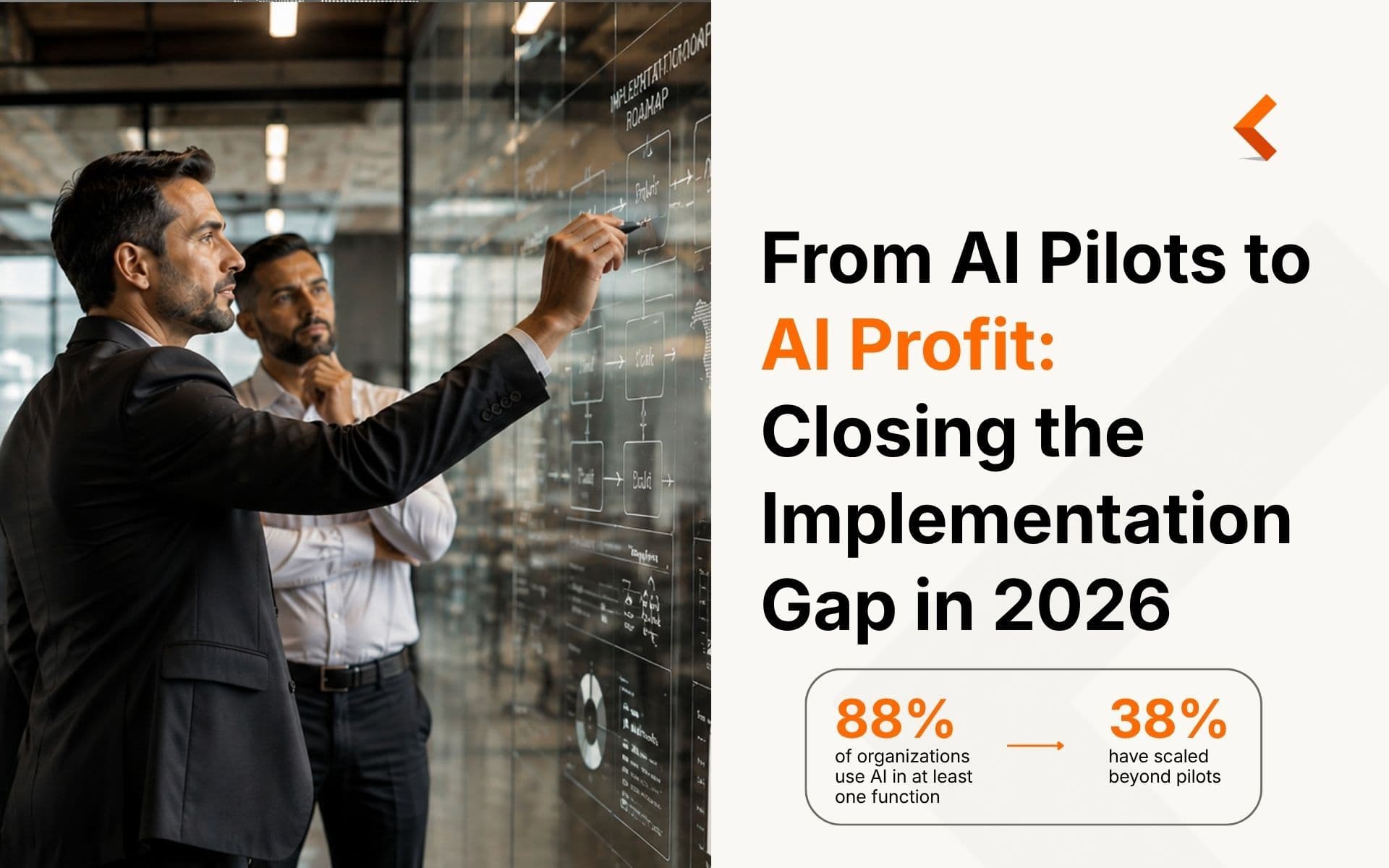
Recent research suggests that 88% of organisations now use AI in at least one function, but only 38% have scaled beyond the initial pilot. Put simply, most firms have tried it. Far fewer have made it part of how the business actually runs.
That's the implementation gap. It's the distance between "we have a few AI tools and some enthusiastic early adopters" and "AI is embedded in our core workflows, it's governed, and we can measure what it's worth."
I see the same pattern again and again. A team runs a promising pilot. People like it. Then it stalls, because nobody redesigned the workflow around it, nobody owns it, and nobody can say with confidence what it saved. Businesses are developing AI, but they aren't necessarily reaping the rewards.
Where AI pays back first
The benefits are clearest in work that's repetitive and high-volume. Operations, finance, customer support, HR, sales operations and commercial enablement are all natural candidates. In those areas, AI can:
- shorten cycle times,
- reduce error rates,
- lift output, and
- free up internal capacity without proportional headcount growth.
Each of those has a direct line to margin, service levels and operating leverage.
But here's the part that often gets missed. The real value isn't the time saved. It's what that time gets used for. When an experienced analyst stops spending two hours a day reconciling spreadsheets, the return on their compensation goes up, because their judgement is now pointed at problems that matter. For leadership teams, the conversation shouldn't be "can AI improve productivity?" It should be "where will the time we get back have the biggest impact on the economics of this business?"
Why manual-heavy firms carry more risk
Firms that still depend heavily on manual processes are more exposed to the things that quietly erode performance: hiring constraints, attrition, training lag and execution bottlenecks. When one key person leaves, a whole process can wobble.
AI reduces that dependency. It creates a more durable operating model with fewer single points of failure and more consistency across the board. In a lower-growth, margin-sensitive environment, that resilience isn't a nice-to-have. It's central to the return profile.
The talent side of the implementation gap
There's one more piece that doesn't get talked about enough: closing the gap takes people. You need someone who understands how the work is really done today, someone who can redesign it, and someone who can bring the organisation through the change. Most companies don't have all of those people in-house, a point our CEO Chris Watkins makes in Why Serious AI Adoption Often Creates More Hiring First.
We've lived this ourselves. CGP rebuilt its own technology stack around AI, and the result is Keystone AI, our AI recruitment platform. It uses AI agents to source, match and interview candidates, with industry specialists validating the results, and it delivers curated shortlists in as little as 72 hours. So when a client tells us they can't find the people to scale their AI programme, we can help on both fronts: the implementation itself, and the talent to run it.
What it costs to close the gap
Mid-market AI consulting and implementation typically starts in the $25,000 to $150,000 range, with broader programmes scaling from there. That market is expected to grow at a compound annual rate of around 20% or more over the next several years, which tells you companies are moving from interest to action.
Whilst AI usage is now widespread, the return on investment is still uneven. That's exactly where the opportunity sits.
How CGP AI helps businesses close the gap
Plenty of firms have trials running. Relatively few have embedded AI into core workflows in a way that's scalable, governable and measurable. That's where companies will compete from here: the ones that turn isolated use cases into lasting improvements in cost, speed and resilience.
Our focus is practical implementation. We identify where the return is strongest, redesign the workflows that matter most, and support the operational shift that makes it stick. We do it with a LATAM-centric model that can save clients up to 51% compared with traditional consultancy costs.
With every client, we start with four questions:
- Where can AI reduce unit cost?
- Where can it help us capture economies of scale?
- Where can it reduce dependence on manual intervention?
- Where can it strengthen resilience without adding complexity?
Those questions sit at the heart of operating performance, and the answers are rarely where people expect.
Planning beats rushing
The firms that benefit most from AI won't necessarily be the ones that rush ahead. They'll be the ones that plan carefully, manage the risk, put a number on the return, and use AI to build a leaner, more resilient operating base. That's how you stay ahead of the curve without betting the business on it.
If your firm is figuring out how to implement AI without taking on enterprise-level consultancy costs, I'd genuinely welcome a conversation.
Want to learn more?
Reach out to Alexander Naughton at alexander.naughton@cgpgroupus.com, or book a demo with our team.
Book a DemoNeed the people to run your AI programme?
Build the teams behind your AI strategy with the talent, expertise, and support you need to turn your AI ambitions into action.
Explore Keystone AIFrequently Asked Questions
What is the AI implementation gap?
The AI implementation gap is the difference between companies experimenting with AI and companies that have actually scaled it. McKinsey's 2025 State of AI survey found that 88% of organisations use AI in at least one function, but only about one-third have started scaling it across the business.
Why do most AI pilots fail to scale?
Most AI pilots stall because the tool is added without redesigning the workflow around it. Without a clear owner, governance and a way to measure the return, a promising pilot never becomes part of how the business runs.
Which business functions see the fastest return on AI?
Repetitive, high-volume functions see the fastest return: operations, finance, customer support, HR, sales operations and commercial enablement. In these areas AI shortens cycle times, reduces errors and frees up capacity without proportional headcount growth.
How much time can AI save employees?
According to Goldman Sachs, employees at companies using enterprise AI tools such as ChatGPT Enterprise save 40 to 60 minutes per day on average. For a 100-person team, that's roughly 17,000 to 25,000 hours of additional capacity per year.
How much does AI implementation cost for a mid-market company?
Mid-market AI consulting and implementation typically starts between $25,000 and $150,000, with larger programmes costing more. CGP AI's LATAM-centric delivery model can save clients up to 51% compared with traditional consultancy costs.
How can companies find the talent to scale AI?
Many companies don't have AI implementation talent in-house. Keystone AI, CGP Group's AI recruitment platform, uses AI agents to source, match and interview candidates, with industry specialists validating results, and delivers curated shortlists in as little as 72 hours.
References:
- The State of AI in 2025: Agents, Innovation, and Transformation, McKinsey & Company
- Goldman Sachs Research, via Fortune, April 2026

Your Global Workforce. Simplified.
Start a conversation to explore how Keystone AI's RaaS ecosystem fits your hiring needs. Whether you're scaling a startup or optimizing enterprise talent operations.