Talent Insights
What Q1 Revealed. What Q2 Demands.
Q1 delivered the data. Q2 will deliver the decisions. Four shifts in executive leadership are defining how boards, sponsors, and C-suite leaders will navigate the rest of 2026.

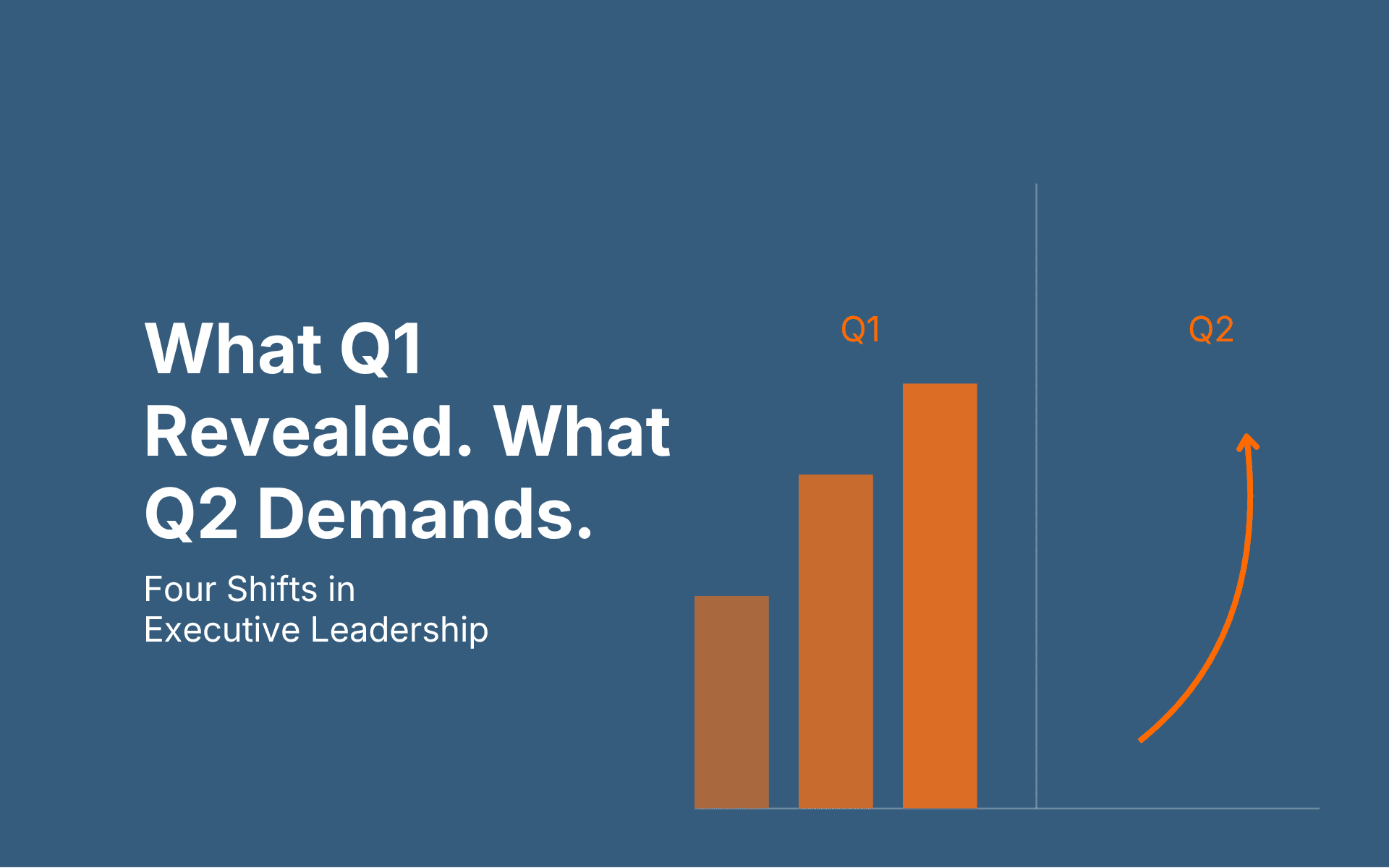
Q1 2026 is behind us. For C-suite leaders, boards, and private equity sponsors, the first quarter delivered something more valuable than predictions: data.
What we have observed across CGP SEARCH engagements, spanning Private Equity, Energy, Clean Technology, Critical Minerals, Industrial Services, and Niche Manufacturing is a market sharpening its expectations of executive leadership. Q2 is where those expectations translate into hiring decisions, capital deployment, and operating plans.
Four shifts stand out.
1. Operational depth is outpacing growth narrative.
The last cycle rewarded executives who could tell a compelling growth story. The current cycle rewards executives who can run the business. Boards and sponsors are asking harder questions earlier: How do you manage working capital? What is your read on margin expansion beyond price? Where does operational leverage come from? The shift is especially clear in PE-backed companies, where sponsors are re-evaluating leadership profiles set two or three years ago under different rate assumptions.
2. Cross-domain fluency is the new baseline for the C-suite.
Financial acumen, technical literacy, and regulatory awareness are converging. A CFO in a clean technology portfolio company now needs to speak credibly about project finance, offtake contracts, and evolving subsidy frameworks. A COO in critical minerals needs to understand permitting as fluently as production. Single-discipline executives remain valuable in functional roles. At the top of the house, cross-domain fluency is becoming table stakes.
3. Workforce strategy has moved from HR to the CEO agenda.
Three forces are converging on the same point. The industrial talent pool is aging faster than it is being replenished. The energy transition is pulling technical talent across sector lines. AI is redefining the work inside every function. Together, these forces have elevated workforce strategy from a functional topic to a CEO-level conversation. Executives who can articulate a workforce thesis beyond a staffing plan are commanding attention in board rooms.
4. Speed of decision-making has become competitive advantage.
Capital cycles are tightening. Hiring cycles are tightening. The gap between decision and action is becoming a measurable source of competitive edge. The executives winning in 2026 are the ones who move with conviction on imperfect information. The boards placing them are doing the same. Long deliberation cycles are quietly moving from diligence to disadvantage.
What Q2 demands
These four shifts share a common thread: alignment. Between board and management. Between capital thesis and operating reality. Between the leader a company hired and the leader a company needs.
Executive search is where that alignment gets tested. A search built on clear role definition, honest market intelligence, and disciplined process converts these shifts from risk into advantage. A search built on urgency alone tends to reproduce the profile a company is already outgrowing.
Q2 is the quarter where 2026 plans meet reality. The executives hired now will define how companies exit the year.
The right leader changes everything.
For confidential conversations about executive search in Private Equity, Energy, Clean Technology, Critical Minerals, Industrial Services, and Niche Manufacturing, reach out to:
Michael Moore |michael.moore@cgpgroupus.com
Related Posts
How to Prepare Website Content for AI Search
Talent Trends 2026: Southeast Asia Market Insights & Salary Guide Report