
Talent Insights
5 Resume Signals That Really Matter | What Candidates and Recruiters Should Look For
Not every resume tells the full story but they leave clues. Here are 5 resume signals that recruiters watch for, what they really mean, and how AI matching is changing the way we evaluate talent.

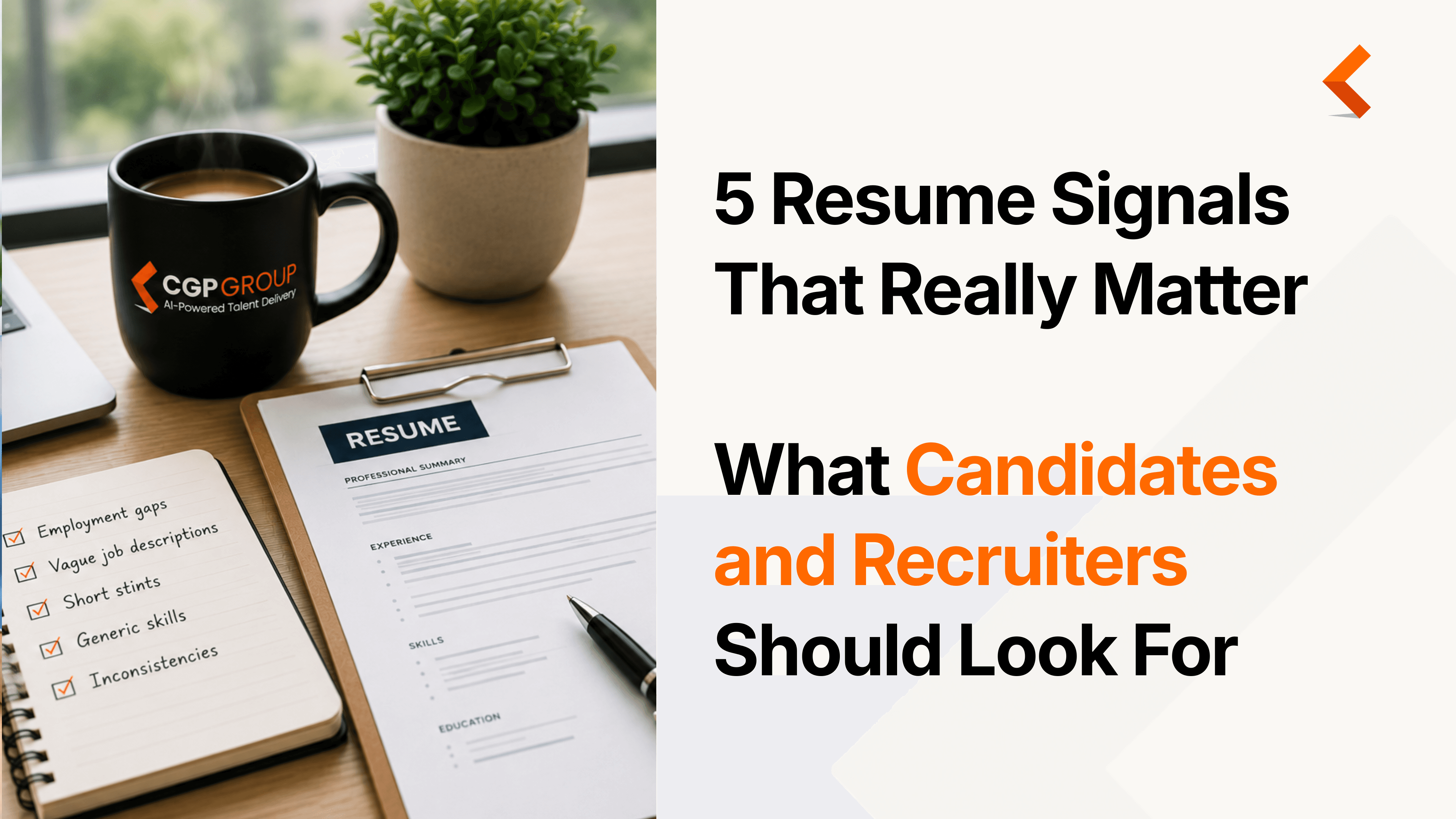
Not every resume tells the full story. But they do leave clues.
For years, resumes have been one of the main tools recruiters use to understand a candidate’s background. They’re useful, but they’re also limited. A resume is a snapshot of someone’s career. It can’t always explain why someone changed jobs, what happened behind a career break, or what a person actually achieved in a role.
That’s why context matters.
As talent matching technology evolves, recruiters can look beyond a resume alone and consider a broader picture of a candidate’s skills, experience and fit. But that doesn’t make the resume irrelevant. It still gives candidates a chance to tell their story and gives recruiters an important starting point for the conversation.
Here are five resume signals worth paying attention to and what they may actually tell you.
1. Unexplained employment gaps
What recruiters see?
A period of time on the timeline with no obvious activity.
What it could mean?
Almost anything. Caregiving, freelance work, further education, a sabbatical, a career change or simply time between roles.
A gap by itself doesn’t tell you much.
Why the context matters?
The important question isn’t necessarily “Why was this person unemployed?” It’s “What was happening during this period?” A six-month gap can mean very different things depending on the person and their circumstances. Without context, a recruiter is left guessing.
For candidates
If you have a gap on your resume, you don’t need to write a long explanation. A short description can be enough:
Career break for family caregiving, 2023–2024 Freelance consulting across multiple clients
That small amount of context can prevent unnecessary questions later.
Where technology can help
Modern talent matching tools can look at a candidate’s overall experience rather than treating a gap as an automatic negative signal. Skills, relevant experience and career history can provide a much fuller picture than a timeline alone.
2. Vague job descriptions with no clear outcomes
What recruiters see?
Managed cross-functional teams. Led product initiatives. Drove marketing strategy.
These statements may all be true. But they don’t tell us much about what actually happened.
What it could mean?
Sometimes a candidate simply hasn’t had the opportunity to explain their impact clearly. In other cases, the role may genuinely have involved limited ownership.
Either way, it’s worth looking deeper.
What matters more than the job description
Titles and responsibilities only tell part of the story. What really helps is understanding what someone changed, delivered or improved.
Compare:
Managed a cross-functional team.
with:
Led a six-person cross-functional launch that reduced time to market from eight months to five.
The second example gives the reader something to work with: scope, ownership, timing and an outcome.
For candidates
A useful way to strengthen your experience section is to think:
What did I do? → What changed? → What was the result?
You don’t need a number for everything. Specific details are often enough to make an experience feel real.
3. A pattern of short stints
What recruiters see?
Several roles in a row, each lasting six to twelve months.
What it could mean?
Again, it depends. Someone might have worked primarily on contracts. They may have joined a startup that changed direction. They could be early in their career and exploring different industries. Or they may simply have moved on from several roles that weren’t the right fit.
One short role usually isn’t a concern. A repeated pattern is more likely to raise questions.
Why context matters?
Career paths aren’t always linear. A five-year career at a startup that went through multiple restructures can look very different from five voluntary moves between companies. The number of companies matters less than the story behind those moves.
For candidates
If your resume contains several short roles, give recruiters enough context to understand them.
Something as simple as:
Contract role — 6 months Startup restructuring led to team wind-down
can answer the obvious question before it becomes a concern.
Where technology can help
A strong match shouldn’t depend on tenure alone. Relevant skills, industry experience and the type of work someone has actually done can be more meaningful when assessing fit for a role.
4. Generic skills sections
What recruiters see?
Good communicator. Team player. Results-driven. Detail-oriented. Self-starter.
The problem is that almost everyone can say these things.
What matters more?
The strongest evidence of a skill usually appears somewhere else in the resume. If someone says they have strong leadership skills, what did they actually lead? If they describe themselves as a strong communicator, where have they had to communicate something difficult, influence a team or explain a complex idea?
The experience itself should do most of the talking.
For candidates
Instead of relying on a long list of soft skills, show those skills through your experience.
Rather than simply writing “leadership,” describe a situation where you led a team, project or change.
Instead of “communication,” mention the presentation, client relationship, publication or difficult conversation where that skill mattered.
Your skills section should reinforce your experience, not try to replace it.
Where technology can help
Talent matching platforms can also look beyond generic keywords and consider how skills appear across a candidate’s experience.
That makes specific examples much more useful than simply adding more buzzwords to a skills section.
5. Inconsistencies between your resume and LinkedIn
What recruiters see?
Different dates, job titles or company names across your resume and LinkedIn profile. Sometimes there’s a perfectly simple explanation. Someone updated LinkedIn but forgot to update their resume. A title may also have changed slightly over time.
But inconsistencies can still create unnecessary questions.
Why consistency matters?
Your resume and LinkedIn profile should tell the same story. They don’t need to be identical, but the basic facts — companies, dates and roles — should line up.
For candidates
Treat your resume and LinkedIn profile as two versions of the same professional story.
When you update one, take a few minutes to check the other. It’s a simple step that can remove a potential source of confusion.
Where technology can help
As more recruitment processes use multiple sources of candidate information, consistency becomes easier to review across a candidate’s professional profile.
But technology should help surface questions, not make assumptions about why something looks different.
What resumes can miss
A resume is useful. It just shouldn’t have to carry the entire story.
Some candidates are naturally good at writing resumes. Others aren’t. Some have spent years building impressive careers but struggle to summarize that experience in two pages.
That can create challenges for people whose backgrounds don’t fit a traditional resume format.
For example:
- Passive talent who aren't actively looking for a new role
- Career changers whose experience spans different industries
- Self-taught professionals whose careers don’t follow a traditional path
- Global talent whose resumes may follow different conventions
- Experienced professionals whose resumes haven’t been updated recently
This is where broader talent matching can add value.
Instead of relying on a resume alone, recruiters can consider the wider picture: relevant skills, experience, role requirements and the evidence available throughout the recruitment process.
The goal isn’t to replace the resume.
It’s to make sure a good candidate isn’t overlooked simply because they aren’t particularly good at writing one.
For candidates: make your resume work harder
Whether a person or a technology is reviewing your resume, a few simple things can make your experience easier to understand.
1. Add context to career gaps
You don’t need to explain everything. Just give enough information to avoid unnecessary questions.
2. Lead with outcomes
Where possible, explain what you changed, delivered or improved, not just what you were responsible for.
3. Explain short roles
If there’s an obvious question about your career history, answer it before someone has to ask.
4. Show your skills through experience
Specific examples are usually more convincing than a list of adjectives.
5. Keep your resume and LinkedIn aligned
Make sure the basic facts match and update both when something changes.
Your resume still matters. But it works best when it’s part of a bigger picture.
For recruiters: look beyond the resume
A resume can be a useful starting point, but it shouldn’t be the only source of information when evaluating talent.
A more complete approach can include:
- Combining resume review with talent matching
- Looking at demonstrated skills and relevant experience
- Considering candidates who don’t use the exact language from the job description
- Using technology to expand the talent pool rather than narrow it too early
- Using human judgment to understand context and make the final assessment
The technology can help recruiters find relevant talent at scale.
The human conversation is still where context, motivation and experience come together.
Frequently asked questions
Are resume gaps really a big deal?
Not necessarily. A gap on its own doesn’t tell you why someone wasn’t working. A short explanation can provide useful context and prevent unnecessary assumptions.
What is the ideal resume length?
For most professionals, one to two pages is a reasonable starting point. The more important question is whether the resume clearly communicates relevant experience and achievements.
Should I include a photo on my resume?
It depends on the market. Photos are generally not expected on resumes in the U.S., while they may be more common in some European, Latin American and Asian markets.
How much time do recruiters spend reviewing a resume?
It varies significantly depending on the recruiter, role and volume of applications. The important takeaway is that recruiters often make an initial assessment quickly, so the top section of your resume should make your experience easy to understand.
Will AI matching replace resumes?
Probably not. Resumes still provide useful context and help candidates organize their professional story. AI-powered matching can complement that information by helping recruiters look at talent more broadly.
How can I know whether a company uses AI in its recruitment process?
Recruitment processes vary. Some companies may use AI for talent matching, sourcing, interviews or other parts of the process. If AI is part of the application process, candidates should receive clear information about how it is being used.
The bottom line
A resume can tell you a lot about someone. It just can’t tell you everything.
The strongest candidates don’t always have the strongest resumes. And a career gap, a short role or a less-than-perfect LinkedIn profile doesn’t automatically mean someone is the wrong fit.
The better approach is to look at the whole picture.
At CGP Group, our recruitment teams work with talent across executive search, contract staffing and workforce solutions. Through Keystone AI, we combine AI-powered talent matching with human expertise connecting the world's talent with the right opportunities, while helping organizations find the talent that fits.
Because the goal isn’t simply to find the perfect resume. It’s to find the right person.
Ready to take the next step?
Whether you’re looking for your next opportunity, exploring talent solutions for your organization, or simply want to learn more about CGP Group, we’re here to help.
Explore your options:
Explore job opportunities
Looking for your next career opportunity? Explore our current openings.
Visit Our Job Portal